Before you begin
- Radians, coordinates, and right-triangle geometry.
Learning objectives
- Evaluate exact unit-circle values.
- Determine signs and domains of the six trigonometric functions.
- Use periodicity, symmetry, and the Pythagorean identity.
Rotating a point around the unit circle produces two coordinates that repeat after each full turn. Sine and cosine record those coordinates as functions of the angle. This construction extends right-triangle ratios to negative angles, angles beyond a right angle, and repeated rotations.
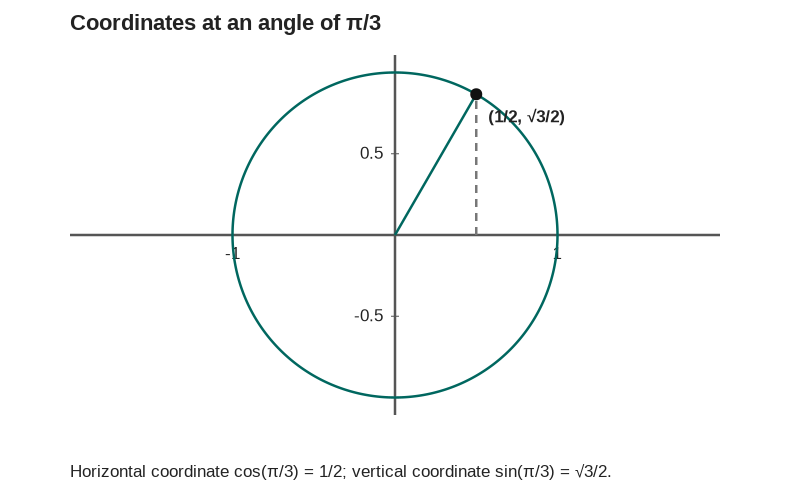
Coordinates define sine and cosine
On the circle , let be the directed angle from the positive horizontal axis to a point . Define and . Every real angle gives one point, so both functions have domain and range .
The four axis directions give
| 1 | 0 | 0 | ||
| 0 | 1 | 0 |
The circle equation supplies the Pythagorean identity . Squares on function values mean and .
Exact values come from two triangles
A square cut along a diagonal gives a right triangle with equal legs. Scaling its hypotenuse to one gives both legs . Hence .
Bisecting an equilateral triangle of side 2 gives a right triangle with hypotenuse 2, short leg 1, and long leg . After scaling to unit hypotenuse, and . Exchanging the acute angles gives and .
These constructions supply magnitudes. The terminal quadrant supplies signs. At , the reference angle is and the point lies in quadrant II, so sine is while cosine is .
Symmetry and periodicity
A full turn returns the same point:
for every integer . Reflection across the horizontal axis negates the angle and vertical coordinate, giving and .
A half-turn negates both coordinates. Thus and . A quarter-turn exchanges the coordinate roles with a sign change, connecting the sine and cosine graphs.
For , subtract to obtain . For , evenness gives . The same few geometric values support many exact evaluations.
The other four functions are ratios
Define
Tangent and secant exclude , where cosine is zero. Cotangent and cosecant exclude , where sine is zero. At , tangent is and secant is .
Dividing the Pythagorean identity by gives on their shared domain. Dividing by gives . The denominator restrictions come from the derivation and remain part of the identities.
Scaling from the unit circle
On a circle of radius , the corresponding point is . For acute angles, dividing the vertical and horizontal coordinates by the hypotenuse recovers the familiar opposite/hypotenuse and adjacent/hypotenuse ratios. The unit-circle definition therefore retains the triangle meanings while allowing a much larger angle domain.
Exercises
- Find and exactly.
- Evaluate .
- Give every angle excluded from the domain of secant.
- If in quadrant IV, find sine and tangent.
- Evaluate using periodicity.
- Find the coordinates on a radius-4 circle at angle .
Worked solutions
- Quadrant III makes both negative: and .
- The ratio is .
- for integers , where cosine vanishes.
- The Pythagorean identity gives . Quadrant IV selects , so tangent is .
- Add to get , giving .
- .
Keep your place
Mark this lesson complete after you've read it, attempted its exercises, and explained its central idea in your own words.
Progress is not saved unless you choose to mark the lesson complete.
Saved only in this browser's local storage. No required account, server transmission, or analytics. You can reset your saved progress on the course page. Clearing browser data also clears the record.