Before you begin
- Trigonometry, coordinates, and conic equations.
Learning objectives
- Eliminate a parameter while retaining the path’s restrictions.
- Convert between polar and Cartesian descriptions.
- Distinguish a curve’s point set from its direction and repeated tracing.
A position can depend on a common parameter even when the path cannot be represented by one function . A circle is an immediate example: the parameter can record the rotation angle while both coordinates change. Polar coordinates offer another description, using direction and distance from an origin.
Parametric equations retain the traversal
The pair , describes points with one shared parameter. Eliminating gives . If , the path is only the segment from to , traversed in that direction.
The Cartesian line equation alone does not retain the parameter range or direction. An elimination step should therefore report the resulting equation together with the inherited restrictions.
For , with , elimination gives . Restricting selects only its nonnegative- branch. Squaring away the sign of a parameter can otherwise add a part of a curve that was never traversed.
A circular parameterization
The equations
satisfy . For , they trace the circle counterclockwise once, starting at and returning there. Restricting to gives only its upper half.
Replacing by preserves the full circle as a point set over but traces it twice. Replacing sine by negative sine reverses the direction. The parameterization contains information beyond the equation of the point set.
Polar coordinates use a reference direction
A polar pair corresponds to
With , is distance from the origin and is a direction, determined up to multiples of for nonzero points. The origin permits every angle.
Signed radial coordinates are also useful: represents the same point as . Thus and both give . State whether negative radial values are permitted when analyzing a polar graph.
To recover the angle of , use its quadrant as well as the ratio of coordinates. Its nonnegative radius is 2 and one angle is . A principal arctangent alone would not select that quadrant.
Convert a polar curve without losing points
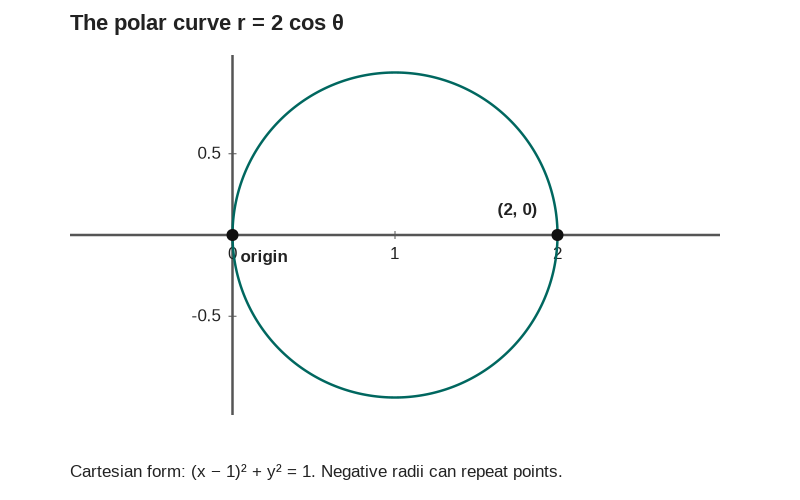
For , multiply by and use :
This is a circle centered at with radius 1. It contains the origin, reached when . Dividing by during a reverse conversion would require checking that origin separately.
With signed radii and , this polar rule traces the circle twice. A Cartesian equation has no record of those repeated visits. Evaluating key angles and following the parameter resolves the tracing question.
Polar complex numbers turn products into rotations
A nonzero complex number can be written with . Multiplying two such forms and applying angle-sum identities gives a product modulus and angle .
Repeated multiplication yields for positive integers . The th roots have moduli and arguments for . Raising each to the th power verifies the formula.
The cube roots of 1 are , , and , equally spaced around the unit circle. The extra full-turn choices in the original argument are what produce distinct roots.
Exercises
- Eliminate from , for , retaining the path restriction.
- Parameterize a radius-2 circle centered at the origin, starting at and moving counterclockwise.
- Convert from polar to Cartesian coordinates.
- Give a nonnegative-radius polar representation of .
- Convert to a Cartesian circle equation.
- List all fourth roots of 1 in both polar-angle and Cartesian form.
Worked solutions
- , so with . The segment runs from to .
- , , .
- .
- One representation is .
- Multiplying by gives , or .
- The arguments are at radius one, giving .
Keep your place
Mark this lesson complete after you've read it, attempted its exercises, and explained its central idea in your own words.
Progress is not saved unless you choose to mark the lesson complete.
Saved only in this browser's local storage. No required account, server transmission, or analytics. You can reset your saved progress on the course page. Clearing browser data also clears the record.