Before you begin
- Unit-circle functions and graph transformations.
Learning objectives
- Read parameters from a sinusoidal formula or graph.
- Construct a periodic model from specified extrema and timing.
- Distinguish tangent behavior from sine and cosine oscillation.
A point rotating at a constant angular speed has a vertical coordinate that rises and falls smoothly. Its height is a sine or cosine function of time. Amplitude, period, and phase connect the circle’s geometry to the timing and scale of that oscillation.
Read the basic graphs through one rotation
As goes from 0 to , passes through at quarter-turn intervals. Cosine passes through at the same inputs. Both have period : translating the input by that amount repeats every output.
A period is any positive shift producing the same values for all inputs. The fundamental period is the smallest such shift. For sine and cosine it is , although and other positive integer multiples are also periods.
The graphs need more than straight segments between five points. Their coordinates arise from continuous circular rotation. A graphing program can sample many points, while the circle determines their exact relationship.
Transform parameters into a model
For
the midline is , amplitude is , and fundamental period is . Its range is . The phase shifts the point pattern horizontally, with the sign of deciding whether is a maximum or minimum.
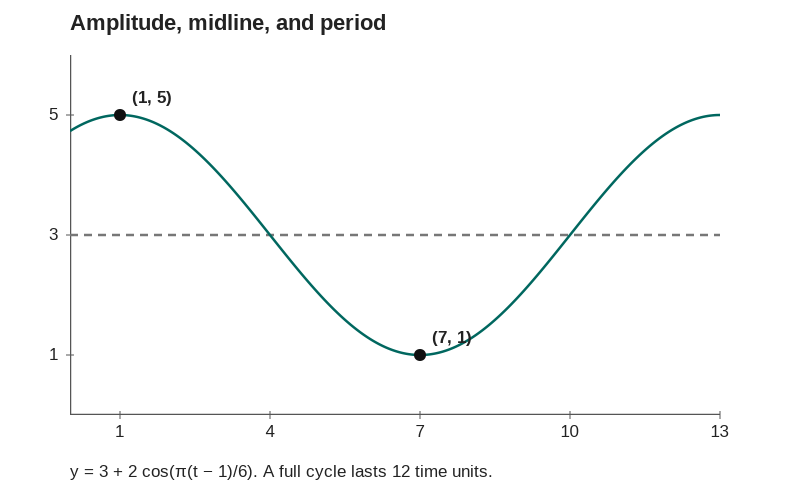
Consider . Its midline is 3, amplitude 2, and period 12. A maximum occurs at , a minimum at , and midline crossings at and 10. The quarter-period spacing is 3, so a table of these key times can guide a sketch.
Factoring the inner expression is useful. In , the expression is , giving phase shift and period . Reading the unfactored constant as the shift would double the timing error.
Build a sinusoid from extrema and timing
Suppose a hypothetical daily quantity ranges from 8 to 20, reaches a maximum at hour 5, and repeats every 24 hours. The midline is , amplitude is , and angular coefficient is . A model is
It reaches its minimum twelve hours after the maximum, at hour 17. The data specified the extrema and period; assuming a sinusoidal shape between them is an additional modeling choice. A daily process with a sharp jump or asymmetric cycle may need a different periodic function.
The same sinusoid can often be written using sine and a different phase. Equivalent formulas should produce the same key values and timing. A phase parameter is not unique because adding a full period leaves the graph unchanged.
Tangent has a different kind of repetition
Since both sine and cosine change sign after a half-turn, their ratio satisfies . Its fundamental period is . Tangent has zeros at and vertical asymptotes at .
Between and , tangent increases from unbounded negative values through zero to unbounded positive values. Its range is all real numbers, so it has no finite amplitude. For , the factor 2 scales outputs and the period becomes , but it still has no amplitude in the bounded-oscillation sense.
Secant and cosecant inherit exclusions from their denominators. Their graphs stay outside because the reciprocal of a nonzero sine or cosine value has magnitude at least one. Use the denominator’s zeros to split the graph into branches before sketching.
Exercises
- Find amplitude, midline, period, and range of .
- Find a maximum time and the next minimum time for .
- Construct a cosine model with minimum 2, maximum 10, period 8, and maximum at zero.
- Give the phase shift and period of .
- Find the zeros and vertical asymptotes of .
- Explain why has no finite amplitude.
Worked solutions
- Amplitude 3, midline 5, period , range .
- A maximum occurs at . Period is 10, so the next minimum is at .
- Midline 6 and amplitude 4 give .
- Factor as , giving shift and period . In this case the shift is one full period.
- Zeros satisfy , so . Asymptotes satisfy , so .
- Tangent is unbounded near each asymptote; multiplying its outputs by 3 preserves that unboundedness.
Keep your place
Mark this lesson complete after you've read it, attempted its exercises, and explained its central idea in your own words.
Progress is not saved unless you choose to mark the lesson complete.
Saved only in this browser's local storage. No required account, server transmission, or analytics. You can reset your saved progress on the course page. Clearing browser data also clears the record.