Before you begin
- Factoring, equations, and graph transformations.
Learning objectives
- Convert between quadratic forms.
- Derive and apply the quadratic formula.
- Find a quadratic model’s optimum on a stated domain.
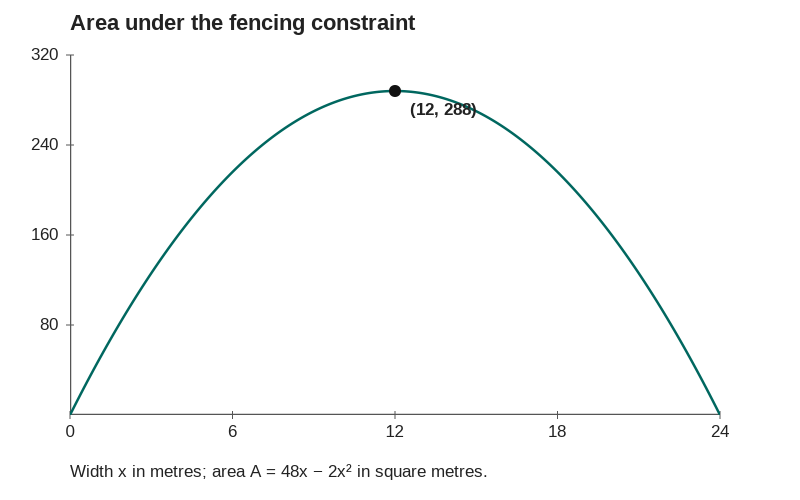
A rectangular enclosure against an existing wall needs fencing on three sides. If 48 metres of fencing are available and each side perpendicular to the wall has length , the third fenced side has length . Its area is on . The resulting quadratic gives us a model whose best feasible value can be found by algebra.
Three forms reveal different features
A quadratic has standard form with . Its graph is a parabola. The sign of determines whether it opens upward or downward, and is its output at zero.
Completing the square gives
Thus the vertex is at with output . In vertex form , the squared term is nonnegative. If , the minimum is ; if , the maximum is , provided the domain includes .
When real zeros exist, factored form reveals the intercepts. Expanding and completing the square connect these descriptions of the same function.
Solving a quadratic by completing the square
Starting with , divide by nonzero , move the constant term, and complete the square:
Taking both signs of the square root yields
The discriminant decides the number of distinct real roots. Positive gives two, zero gives one repeated root, and negative gives none. The complex-number chapter will extend the last case.
For , and the roots are , namely 2 and . The factorization provides an independent check.
Feasible domains decide whether a vertex is available
For the enclosure,
The vertex lies in , giving parallel side 24 and maximum area 288 square metres. Both endpoints give area zero. Completing the square has established the maximum across the entire feasible interval.
If the site requires , the unconstrained vertex is no longer feasible. On , increasing moves closer to 12 and reduces , so the maximum occurs at , with area 280. We cannot report the vertex without checking the model’s restrictions.
Quadratic inequalities follow the zeros
For , factor . The upward-opening parabola is nonpositive between its two zeros, giving . For , the completed square is already a square plus a positive constant, so the inequality holds for every real input without any real zeros.
A root and an inequality boundary are related but distinct objects. A repeated root such as that of touches zero without changing the expression’s sign.
Recovering a quadratic model
If a quadratic has zeros 1 and 5 and passes through , write . The additional point gives , hence . Its symmetry axis is halfway between the roots, , and . Using a form that matches the given information avoids solving an unnecessary three-coefficient system.
Exercises
- Complete the square for and give its minimum.
- Solve .
- Determine the number of real roots of .
- Solve .
- Maximize on .
- Find the quadratic with zeros that passes through .
Worked solutions
- , with minimum 2 at .
- The factorization gives .
- The discriminant is , so there are no real roots.
- between the roots, giving .
- The unrestricted vertex is 15, outside the domain. The function increases toward it throughout , so the maximum is .
- Write . At zero, , giving and .
Keep your place
Mark this lesson complete after you've read it, attempted its exercises, and explained its central idea in your own words.
Progress is not saved unless you choose to mark the lesson complete.
Saved only in this browser's local storage. No required account, server transmission, or analytics. You can reset your saved progress on the course page. Clearing browser data also clears the record.