Before you begin
- Completing squares, coordinate distance, and quadratics.
Learning objectives
- Identify and transform circles, parabolas, ellipses, and hyperbolas.
- Recover centers, vertices, and foci from standard forms.
- Derive a conic equation from a geometric constraint.
A circle consists of points a fixed distance from a center. Other conic sections arise from related distance constraints: equal distances from a point and a line, a fixed sum of distances from two points, or a fixed absolute difference of those distances. These definitions explain the parameters in their standard equations.
A parabola compares a point with a line
Let the focus be and directrix be , with . A point is equidistant from them when
Squaring and simplifying gives . This equation automatically has , so the resulting distances satisfy the original equality. The vertex is the origin and the axis is horizontal.
Translations give , with vertex , focus , and directrix . Allowing negative opens the parabola leftward. Exchanging the coordinate roles gives a vertical-axis parabola .
For , , so the focus is and directrix is .
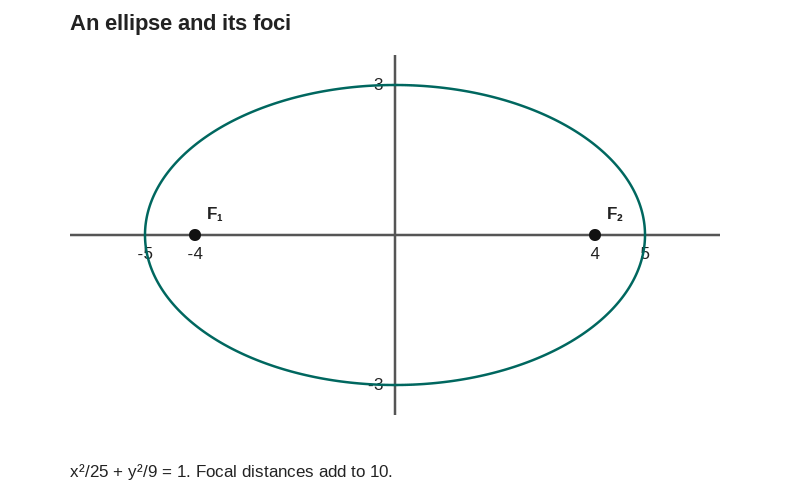
An ellipse fixes a sum of distances
Place foci at and require their distance sum to be , with . If are the two distances, then
Dividing the second relation by the first gives , hence . Squaring this distance formula and simplifying yields
The horizontal vertices are and vertical endpoints are . The major axis has total length . When , and the ellipse is a circle.
For , the semi-axis lengths are 5 and 3. Since , the foci are . Exchanging the larger denominator to the term makes the major axis vertical.
A hyperbola fixes a difference
For foci , a fixed absolute distance difference with gives
The same sum-and-difference algebra produces this equation, but the difference condition allows two branches rather than a closed curve. Vertices are , and the asymptotes are .
For , the foci are and asymptotes are . The relation for differs from the ellipse relation because one squared coordinate is subtracted.
If the positive squared term is the term, the branches open upward and downward. Translating both coordinates moves the center and the asymptote intersection together.
Completing squares recovers a shifted conic
Consider
Group by coordinate and complete squares:
Dividing by 36 gives . The center is , semi-axis lengths 3 and 2, and foci .
A second-degree equation can also be degenerate. For , the only real point is the origin. For , no real points exist. Classify the resulting real set after completing squares rather than assigning every quadratic equation a nondegenerate conic.
Exercises
- Find the vertex, focus, and directrix of .
- Find the center and radius of .
- Find the semi-axis lengths and foci of .
- Find the vertices and asymptotes of .
- Describe the real set .
- Write the ellipse centered at the origin with horizontal semi-major axis 6 and foci .
Worked solutions
- Vertex , , focus , directrix .
- Completing squares gives , so center and radius 2.
- Semi-axes 4 and ; , giving foci .
- Vertices and asymptotes .
- Factoring gives , a pair of intersecting lines.
- , , so . The equation is .
Keep your place
Mark this lesson complete after you've read it, attempted its exercises, and explained its central idea in your own words.
Progress is not saved unless you choose to mark the lesson complete.
Saved only in this browser's local storage. No required account, server transmission, or analytics. You can reset your saved progress on the course page. Clearing browser data also clears the record.