Before you begin
- Factoring, sign charts, and polynomial division.
Learning objectives
- Find the domain, intercepts, and holes of a rational function.
- Analyze vertical and end behavior.
- Distinguish an original rational function from a continuous extension.
The formula looks like a line after cancellation, but its original denominator excludes one point. Another quotient, , grows without bound near that same excluded input. Rational-function analysis begins by distinguishing the reasons an input is missing.
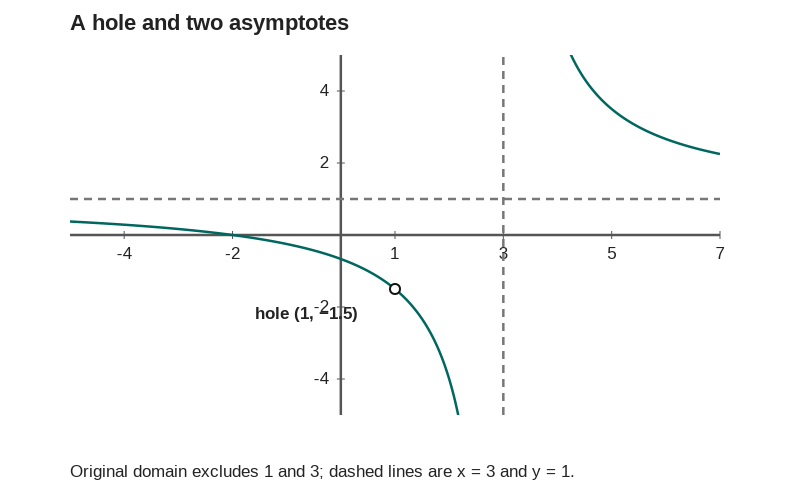
Factor before interpreting the graph
A rational function is defined where . Write those exclusions before cancelling factors. For
the domain excludes 1 and 3. Away from these inputs the function equals . At 1 the simplified formula would give , so the original graph has a hole at .
At 3 a denominator factor remains. The numerator approaches 5 while becomes small with opposite signs on the two sides. The outputs become negative without bound from the left and positive without bound from the right. The line is a vertical asymptote.
A common factor can reduce a denominator’s multiplicity without removing it completely. For , cancellation leaves on , so the missing input still produces unbounded behavior. Inspect the remaining factors rather than classifying every cancellation as a hole.
Intercepts and signs retain the domain
A horizontal-axis intercept occurs when the numerator is zero and the function is defined. In the example, gives an intercept, while the cancelled zero does not. The vertical intercept is .
For the simplified quotient , signs are positive on , negative on , and positive on . The hole at 1 divides the original domain but does not change the sign of nearby outputs. Marking both numerator zeros and denominator exclusions keeps these facts visible in a sign chart.
Division identifies the end trend
Polynomial division rewrites the example as
For large positive or negative inputs, the second term becomes small, so the horizontal line describes the end behavior. A horizontal asymptote concerns unbounded input values; it does not forbid the graph from crossing that height at a finite input.
For , division gives
Its difference from the line becomes small as grows. This is a slant asymptote. More generally, polynomial division can give a higher-degree polynomial trend when the numerator degree exceeds the denominator degree by more than one.
The familiar degree comparisons follow from this division or from dividing by the highest denominator power. A numerator of lower degree gives horizontal asymptote zero. Equal degrees give the ratio of leading coefficients. For larger numerator degree, carry out division rather than assuming a horizontal asymptote.
Reciprocal models carry physical restrictions
A rectangle of fixed area 24 square metres has width for length . The algebraic function also exists for negative , but that branch has no role in the rectangle model. As positive length decreases toward zero, required width grows without bound. This explains the reciprocal behavior geometrically.
For a travel time with fixed positive speed , time is linear in distance. If distance is fixed and speed varies, is instead reciprocal. Identifying which quantity is the input distinguishes the two models.
Extensions are new specifications
Assigning would fill the hole in the first example, creating a continuous extension at that input. It would not change nearby values or remove the asymptote at 3. Calculus will use this distinction between a function’s value and its nearby behavior to define limits precisely.
Exercises
- Find the domain and hole of .
- Find the vertical asymptotes of .
- Find the horizontal asymptote of .
- Divide to identify its slant asymptote.
- Find the horizontal-axis intercepts of on its original domain.
- A rectangle has area 36. Find the width at length 4 and describe the effect of doubling length.
Worked solutions
- The domain excludes 2. The simplified formula is , so the hole is .
- The denominator zeros are , neither cancelled by , giving asymptotes .
- Equal degrees give the leading-coefficient ratio .
- The quotient is , so the slant asymptote is .
- The only numerator zero is 1, which is excluded. There are no horizontal-axis intercepts.
- Width is . Doubling the positive length halves width because the area stays fixed.
Keep your place
Mark this lesson complete after you've read it, attempted its exercises, and explained its central idea in your own words.
Progress is not saved unless you choose to mark the lesson complete.
Saved only in this browser's local storage. No required account, server transmission, or analytics. You can reset your saved progress on the course page. Clearing browser data also clears the record.