Before you begin
- The preceding algebraic, trigonometric, and sequence chapters.
Learning objectives
- Investigate one connected model with units and a feasible domain.
- Simplify a difference quotient without assigning a value at zero.
- Identify which earlier topic resolves a cumulative modeling problem.
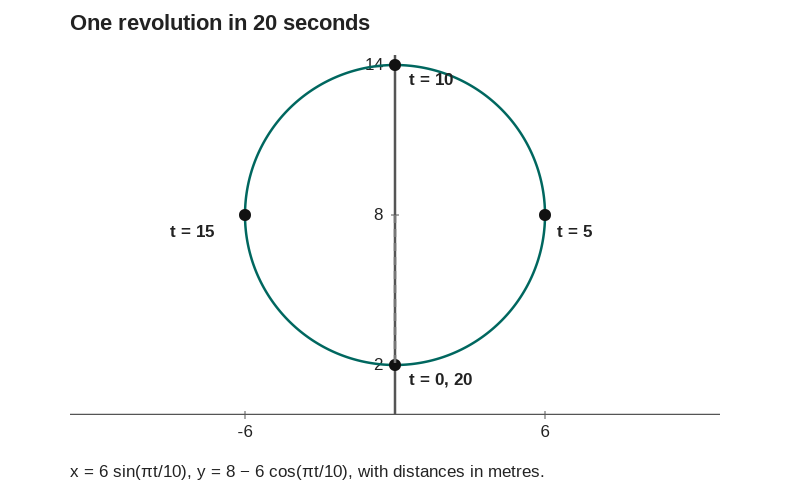
A hypothetical observation wheel has radius 6 metres and an axle 8 metres above level ground. A rider begins at the lowest point and moves counterclockwise at constant angular speed, completing a revolution every 20 seconds. This one model lets us connect coordinates, trigonometric functions, inverse branches, interval solutions, and sampled sequences.
Construct the position before calculating heights
Let , with in seconds. Taking the axle’s horizontal coordinate as zero, the position is
At , the coordinates are . At 5, 10, and 15 seconds, they are , , and . At 20 seconds the rider returns to the start. The radius, initial point, and rotation direction all appear in these checks.
Eliminating the parameter gives . This describes the circle, but the parameterization also supplies timing and direction. The rider’s path length during one quarter-turn is metres, whereas the magnitude of the quarter-turn displacement is metres.
The constant speed along the circle is metres per second. The vertical coordinate does not change at this constant rate, since equal time steps move through different portions of the circle.
Solve a threshold condition on the modeled interval
To find when the height is at least 11 metres, solve
During one turn, the angular interval is . Converting back to time gives . The two endpoints correspond to the same height on the rising and falling portions.
The minimum modeled height is 2 metres. If an alternative site placed the axle below 6 metres while keeping the same radius and a full circular path, the model would put part of that path below ground. The geometric feasibility check comes from the range, before any more elaborate calculation.
Restrict the domain to recover time from height
Height alone does not identify a unique time during the full turn. On , cosine decreases from 1 to , so height increases from 2 to 14 and can be inverted:
The falling time for the same height is . At the top and bottom, duplicated endpoint descriptions should be interpreted within the chosen time interval.
This inverse also exposes sensitivity. Heights just above the lowest point correspond to small but nonzero travel times; equal height increments do not correspond to equal time increments throughout the rise. A sensor’s height tolerance should therefore be carried through the inverse rather than replaced by a constant time tolerance.
Sampling produces a periodic sequence
At five-second intervals, the heights are . An explicit sequence is for nonnegative integers . It is periodic with index period four.
The sequence is neither arithmetic nor geometric: its successive differences and ratios do not stay fixed. The correct model family is determined by the update pattern, not by the fact that values arrive at integer indices.
An algebraic preparation for instantaneous change
For a separate accumulation model, let litres on minutes. The average rate from 2 to is
At the average is 7.1 litres per minute; at it is 6.9. Smaller increments suggest the common target 7. The original quotient remains undefined at zero. The algebra has shown what every permitted nonzero increment does, which prepares the limit question developed in Calculus I.
Cumulative exercises
- Find the wheel’s range of heights and verify its lowest point.
- Find all times in at which the wheel height is 8 metres.
- Find all times in at which the height is 5 metres.
- Recover the first rising time at height 11 using the inverse.
- Find the arc distance traveled in the first 10 seconds.
- Change the period to 30 seconds while retaining the original geometry and starting point. Write both coordinates.
- For , find the average rate from 1 to 3 minutes.
- Simplify and identify the excluded increment.
- Solve on its original real domain.
- A sequence follows with . Find its explicit form and limit.
Worked solutions
- The range is , since cosine ranges from to 1. At zero, .
- Cosine is zero at angles and , giving seconds.
- Cosine must equal , at angles and . The times are and seconds.
- The inverse gives seconds.
- A half-turn has arc length metres.
- The new angular coefficient is , giving and on .
- and , so the rate is litres per minute.
- Factoring the numerator gives , so the quotient is for .
- The right side requires . Squaring gives , with candidates 4 and . Only 4 is allowed, and .
- The fixed point is 6. Deviations halve, giving and limit 6.
Independent investigation
Choose a different radius, axle height, period, and starting point. State the geometric assumptions, write a position model, find its height range, and solve a nontrivial height threshold over one revolution. Identify an interval on which height determines time uniquely. Include a coordinate check, an exact trigonometric calculation, and a numerical approximation whose rounding you explain. Use the earlier chapters to justify each modeling choice.
Keep your place
Mark this lesson complete after you've read it, attempted its exercises, and explained its central idea in your own words.
Progress is not saved unless you choose to mark the lesson complete.
Saved only in this browser's local storage. No required account, server transmission, or analytics. You can reset your saved progress on the course page. Clearing browser data also clears the record.