Before you begin
- Function notation, domains, and coordinate graphs.
Learning objectives
- Transform coordinates under a changed function formula.
- Determine transformed domains and ranges.
- Use even and odd symmetry in graph analysis.
Suppose a temperature profile is known as a function of time. Delaying the process changes when each temperature is reached; adding a fixed temperature changes the output without changing the timing. Input and output transformations distinguish these operations and let us build a new graph from coordinates on a known one.
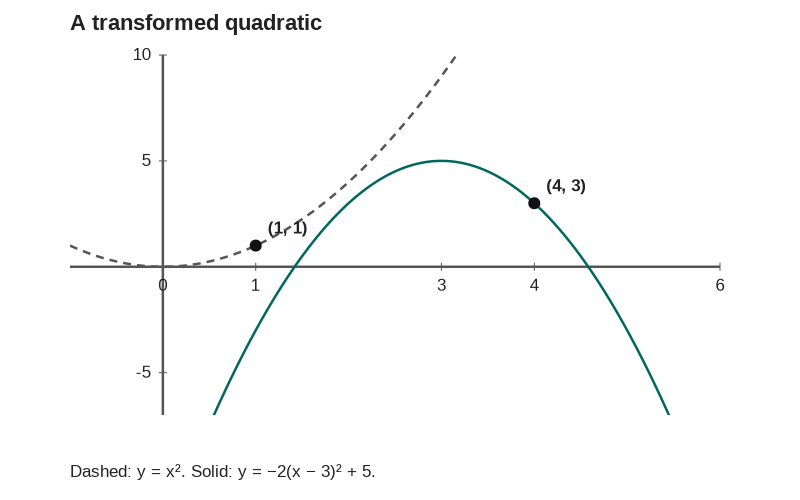
Follow a point through the formula
Let
If is on the graph of , then . To obtain that same inner input in , solve , giving . Its new output is . Thus the point mapping is
The horizontal factor is reciprocal because we solve for the new input. This is the reason compresses a graph horizontally by two while stretches it vertically by two.
For and , the point maps to and to . The vertex maps from to . Reflection in the horizontal axis and vertical stretching are contained in the factor .
Domains and ranges transform too
The domain of consists of inputs for which belongs to the original domain. If , then requires and has range .
For , the same input restriction holds but outputs now lie in . Multiplying an output interval by a negative number reverses its endpoint order.
If the original function is specified only on and , the domain condition is . Solving gives . The negative horizontal factor reflects and compresses the original interval.
The order of operations affects a shift
The formulas and are identical. Factoring the inner expression makes the shift visible. Describing as a shift right by 6 would give the wrong coordinate mapping.
Output operations also have an order. The function shifts up by 3 before stretching outputs by two, producing . The function stretches first, then shifts up by 3. Applying the point mapping avoids relying on a verbal list whose order may be unclear.
Symmetry can reduce the work
An even function satisfies on a domain symmetric about zero. Its graph reflects across the vertical axis. For , the two inputs produce equal squares.
An odd function satisfies on a symmetric domain. Its graph is invariant under a half-turn about the origin. The cube function is odd, while is neither even nor odd. A formula can resemble an even expression but lose this property if its specified domain is not symmetric.
Translating an even graph horizontally moves its line of symmetry. The graph of is symmetric about , although this new function is not even as a function of . The inherited geometric symmetry and the formal evenness condition refer to different centers.
Absolute values change branches
The function reflects negative outputs upward and retains nonnegative outputs. For , the result is a V with vertex . The function instead uses only the original graph’s nonnegative-input branch and reflects that branch across the vertical axis.
For , these give and , with different vertices. Testing the input zero gives outputs 2 and , making the distinction visible before drawing either graph.
Exercises
- Find the vertex, domain, and range of .
- Map the point from to .
- Find the domain and range of .
- Is even, odd, or neither on ?
- Compare and when .
- For with domain , determine the domain of .
Worked solutions
- Vertex , domain , range .
- The new input is and output , giving .
- Domain and range .
- Replacing by negates every term, so it is odd.
- The first is and the second . Horizontal compression has squared the factor through the quadratic.
- Solve , giving .
Keep your place
Mark this lesson complete after you've read it, attempted its exercises, and explained its central idea in your own words.
Progress is not saved unless you choose to mark the lesson complete.
Saved only in this browser's local storage. No required account, server transmission, or analytics. You can reset your saved progress on the course page. Clearing browser data also clears the record.